Your Team Wants n8n. Your Architect Wants LangGraph. Both Are Right.
This looks like a tool choice. It is a decision about who carries the system once it works.
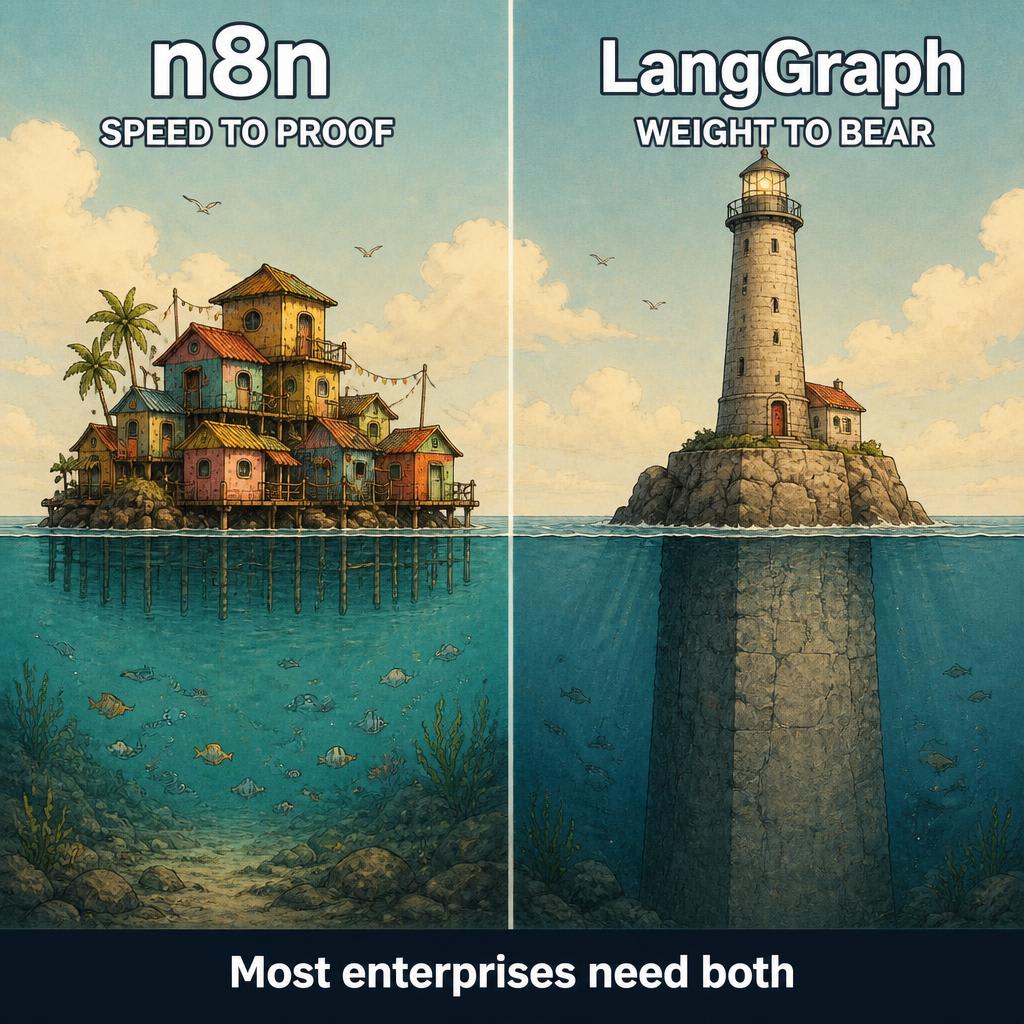
Your Team Wants n8n. Your Architect Wants LangGraph. Both Are Right.
*This looks like a tool choice. It is a decision about who carries the system once it works.*
Someone on your team has built something useful in n8n over a long weekend. Someone else, usually with more scars, is arguing that it needs to be rebuilt properly in LangGraph before anyone depends on it.
Both of them are correct, and they are not disagreeing about tools. They are answering different questions.
What each one actually is
n8n is a visual canvas. You drag nodes onto a screen, connect them, and have something running in days. Hundreds of prebuilt connectors mean nobody writes an integration from scratch. People who are not engineers can build with it, change it, and fix it.
LangGraph is code. You define the system's reasoning as a graph, with explicit state, branching and loops. Nothing is prebuilt. Everything is controllable, and everything is your responsibility.
The usual framing is speed versus power. That is not the decision.
The decision is who carries the operational burden, and what it costs you to be wrong.
When n8n is the right answer
When the question is still "does this idea work?"
You are buying time-to-proof. Six weeks becomes six days. The team that owns the process can change it without waiting for a release cycle. If the idea turns out to be wrong, you lost a fortnight rather than a quarter, and you found out early.
A concrete case: every incoming support ticket gets categorised, tagged with urgency, and routed to the right queue. Ten nodes, live by Thursday, adjusted by the operations lead the following week when the categories turn out to be wrong.
That is a workflow. It runs the same way every time. There is nothing in it that needs to reason.
When LangGraph is the right answer
When the question is "can we run this at scale, and prove what it did?"
You are buying control and auditability. Genuine state management across steps. Branching that depends on what the system found. Retries that behave sensibly under load. A structure you can walk a risk committee through.
A concrete case: an agent reviewing a supplier contract, deciding which clauses need checking, looping until it has gathered enough evidence, escalating what it cannot resolve, and logging every step for audit.
That is not a workflow. The path through it is decided at runtime, and the path itself is something you will eventually be asked to explain.
It costs more to build and it needs engineers to keep it alive. Both of those are real, ongoing costs, not one-time ones.
What most enterprises actually land on
Neither, alone.
n8n handles the triggers, the integrations, the data movement — the parts that benefit from being visible and editable by the people closest to the process. LangGraph runs the reasoning underneath, where the logic is complex enough that you want it in code and under version control.
The visual layer for what is easy to see. The code layer for what has to be right.
This is not a compromise. It is the shape most mature deployments settle into, because the two tools are good at genuinely different things.
The failure mode that actually happens
Almost nobody picks the wrong tool.
What happens instead is more ordinary. A team picks n8n for a pilot. The pilot works. It quietly becomes something the business depends on. And at no point did anyone decide what should happen on the day it stopped being an experiment.
Six months later there is a workflow nobody owns, running logic nobody documented, that finance now relies on for a number in a monthly report. Rebuilding it is expensive. Leaving it is worse.
The tool was never the problem. The absence of a decision about the second phase was.
The question worth asking first
Before you choose between them, answer this: what happens to this build if it works?
Who owns it. Who maintains it. What has to be true before anyone outside the team relies on it. What triggers the rebuild, and who is allowed to call it.
If you cannot answer those, the tool comparison is premature. You are not choosing between n8n and LangGraph. You are choosing whether to make a decision now or inherit one later.
Which of the two you pick matters far less than knowing which question you are answering.
Read more on: https://www.linkedin.com/feed/update/urn:li:activity:7500411363249553408/
Last updated